If you have spent any time evaluating peptide suppliers, you have encountered the term GMP — Good Manufacturing Practice. Some suppliers prominently feature it in their marketing; others make no mention of it at all. Understanding what GMP actually means, when it matters, and when it does not is one of the most practically important pieces of knowledge a researcher can have before placing a peptide order. This article breaks down the real difference between GMP and non-GMP peptide suppliers, what each designation implies about quality control, when each type of supplier is appropriate for your research program, and how to evaluate non-GMP suppliers who may still deliver excellent quality for certain research contexts.
 All peptide products discussed in this article are for laboratory and scientific research purposes only.
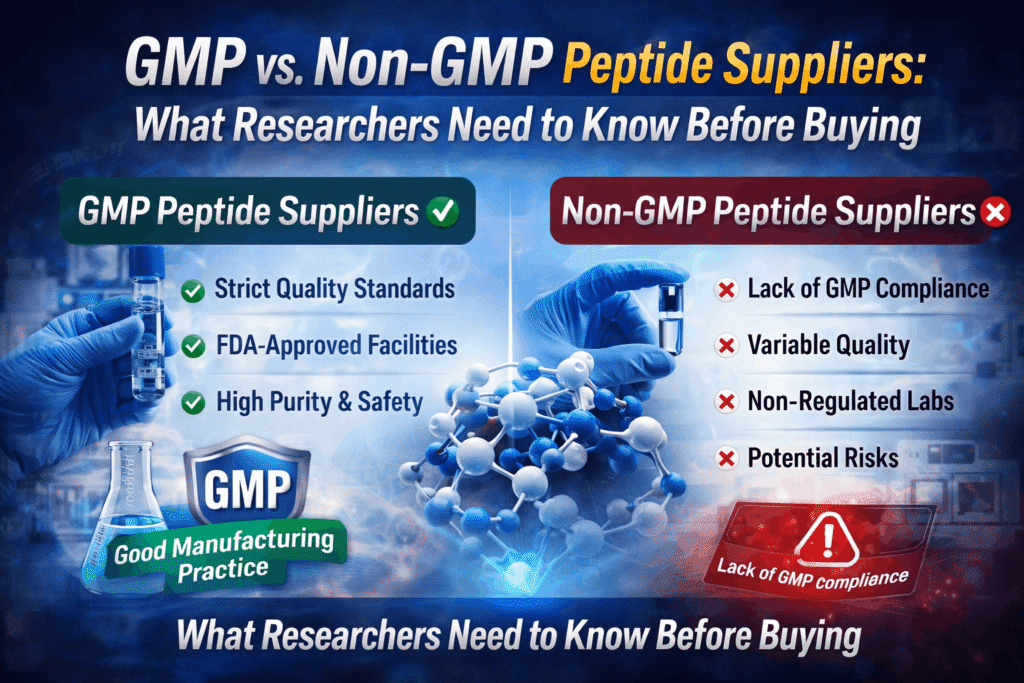
Good Manufacturing Practice (GMP) is a system of regulations and quality standards enforced by regulatory agencies — including the FDA in the United States and EMA in Europe — that governs the production of pharmaceutical products. GMP compliance covers facility design and sanitation, personnel training and documentation, equipment qualification and calibration, raw material testing, in-process controls, finished product testing, batch record keeping, and change control procedures.
For peptide manufacturers, GMP compliance means that every step of the synthesis, purification, and packaging process is documented, validated, and auditable. An FDA inspector can walk into a GMP facility and trace the entire history of any batch from raw materials to final product. This level of documentation and control is specifically designed to ensure that pharmaceutical-grade products are safe, effective, and reproducible.
A non-GMP peptide supplier is not necessarily a low-quality supplier. Non-GMP simply means the supplier does not operate under the full regulatory framework required for pharmaceutical drug manufacturing. In the context of research peptide suppliers, non-GMP typically describes vendors who apply their own internal quality controls — which may be rigorous or minimal depending on the company — without formal GMP certification or FDA inspection history.
The best non-GMP research peptide suppliers in the USA apply many of the same quality principles as GMP facilities — third-party HPLC and mass spectrometry testing, batch record keeping, per-lot COAs — but without the full infrastructure, documentation burden, and regulatory audit trail that GMP certification requires. For research-grade peptides intended for laboratory use, this can be entirely appropriate.
GMP-grade peptides are required when your research output feeds into a regulatory submission. The clearest cases include: IND (Investigational New Drug) applications with the FDA, clinical trial material manufacturing, and any peptide API intended for human administration. If your peptide research is part of a drug development program that will eventually require FDA review, your API must be produced under GMP at the appropriate phase of development.
GMP is also the correct standard for: peptides used in validated diagnostic assay kits intended for clinical use, reference standard materials used in regulated analytical methods, and any research program operating under GLP (Good Laboratory Practice) requirements.
For the vast majority of academic research, basic science laboratory studies, and early-stage discovery work, non-GMP research-grade peptides are entirely appropriate — and using GMP material would be unnecessarily expensive without adding scientific value. If you are running in vitro cell assays, exploring peptide binding kinetics, or conducting exploratory animal studies in an academic setting, well-documented non-GMP peptides from a reputable U.S. supplier will serve your research needs.
The key is not GMP vs. non-GMP per se — it is whether the supplier applies documented, verifiable quality controls that give you confidence in what you are receiving. A non-GMP supplier with dual ISO/IEC 17025-accredited third-party testing and per-lot COAs may deliver more verifiable quality assurance than a supplier claiming GMP compliance with no inspection history or documentation transparency.
Apply these criteria to any non-GMP research peptide vendor before ordering:
Testing Laboratory Credentials: Ask for the name of the testing laboratory used for HPLC and mass spectrometry analysis. Verify that laboratory’s ISO/IEC 17025 accreditation status. This single step eliminates the majority of low-quality suppliers.
Per-Lot COA Availability: The COA should be specific to the batch you are purchasing — not a generic document. It should include the lot number, testing date, HPLC purity percentage, and mass spec confirmation of molecular weight.
Endotoxin and Sterility Testing: For cell-based or in vivo research, ask whether endotoxin (LAL) testing is included. This is not universally standard among non-GMP suppliers but is an indicator of quality investment.
Manufacturing Location: Domestic USA manufacturing provides regulatory jurisdiction, traceability, and practical recourse. Offshore manufacturing with no U.S. presence introduces supply chain risk that is worth factoring into your sourcing decision.
Even within the GMP category, there is meaningful variation. Phase I clinical trial material can be manufactured to a less stringent GMP standard than Phase III or commercial-scale production. Researchers evaluating CDMO partners for drug development programs should ask specifically about the GMP tier — early-phase GMP, late-phase GMP, or commercial GMP — and whether the facility has been inspected by the FDA for the specific product class relevant to their program.
U.S. CDMOs like AmbioPharm, CPC Scientific, Lonza, and Asymchem operate at the pharmaceutical GMP tier. Research-grade suppliers like AminoVault, Core Peptides, and BioLongevity Labs apply research-grade quality systems without formal GMP certification — which is appropriate for their intended use case.
The GMP vs. non-GMP decision is really a question of intended use. Know what your research requires, apply the right verification criteria to whatever supplier tier you use, and never substitute marketing language for documented quality evidence. For a complete breakdown of the U.S. peptide supplier landscape across both tiers, including CDMOs, GMP manufacturers, and research-grade vendors, see our guide to the top 50 best peptide companies in the USA.
All peptide products are for laboratory and scientific research purposes only and are not intended for human consumption or clinical application.