$331.50 Original price was: $331.50.$255.00Current price is: $255.00.
Out of stock
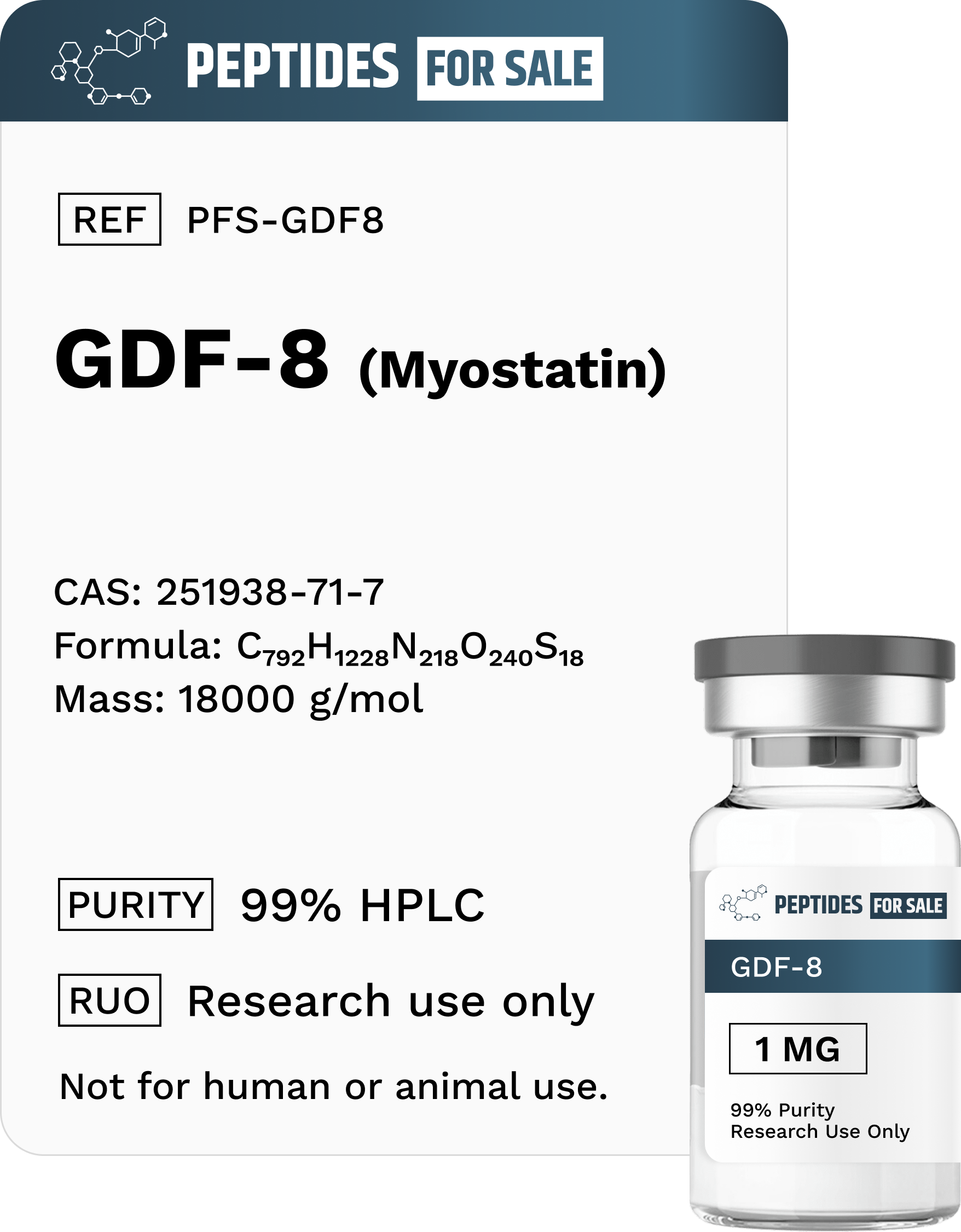
GDF-8 (myostatin) is a TGF-β superfamily growth factor studied for ActRIIB/SMAD signaling and the regulation of skeletal muscle growth in cell and animal models.
GDF-8, better known as myostatin, is a secreted growth factor in the transforming growth factor-beta (TGF-β) superfamily. It is produced mainly in skeletal muscle and is synthesized as a precursor that is cleaved into an N-terminal prodomain and a C-terminal mature domain. The active form is a disulfide-linked dimer of the mature domain.
Myostatin was identified in 1997 by Alexandra McPherron and Se-Jin Lee, who showed that mice lacking the gene developed substantially larger skeletal muscles. Naturally occurring loss-of-function mutations account for the heavy muscling of Belgian Blue and Piedmontese cattle, and similar mutations have been described in whippets.
The mature dimer binds the activin type II receptor ActRIIB, which recruits the type I receptors ALK4 or ALK5. This complex phosphorylates SMAD2 and SMAD3, which move to the nucleus with SMAD4 to regulate gene expression. In muscle cells, this signaling restrains myoblast proliferation and differentiation and dampens the Akt/mTOR protein synthesis pathway. Myostatin activity is held in check by binding proteins such as follistatin and by its own prodomain, which are frequent subjects of inhibitor research.
For research use only. Not for human or veterinary use. Not a drug, food, or cosmetic. Sold to qualified researchers for in-vitro and laboratory research.
| Weight | 1mg |
|---|