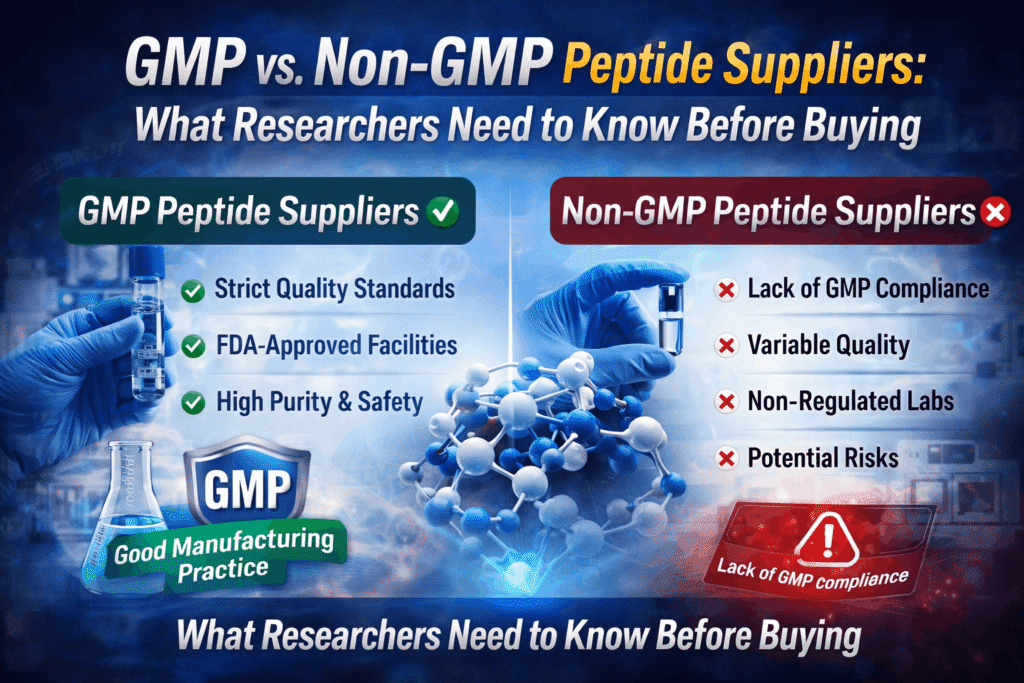
The reproducibility and validity of any peptide research depends fundamentally on the quality of the compounds being used. A peptide that is 80% pure is not the same compound as one that is 99%+ pure — the 20% impurities may be inactive analogues, synthesis byproducts, residual solvents, or even biologically active contaminants that can confound research outcomes.
Yet the research peptide market is highly variable. Vendors range from pharmaceutical-grade domestic manufacturers to overseas grey-market suppliers with no quality control infrastructure. Knowing how to evaluate, verify, and select a trustworthy research peptide supplier is one of the most important skills a researcher in this field can develop.
This guide covers everything you need to know before purchasing research peptides in 2026 — from understanding purity testing methods to identifying red flags in vendor practices.
When a vendor claims “99%+ purity,” this refers to the percentage of the product that is the intended peptide compound, as measured by a specific analytical method. The most common methods used to verify peptide purity are:
HPLC is the gold standard for peptide purity testing. It works by separating the components of a sample by their physical and chemical properties, then quantifying each peak relative to the total. A purity of 99%+ by HPLC means that 99% or more of the detected material is the target peptide.
What to look for in an HPLC report:
Mass spectrometry confirms the molecular identity of the peptide by measuring the mass-to-charge ratio of ionized molecules. A high-quality CoA will show MS data alongside HPLC confirming:
For some peptides, amino acid analysis confirms the exact amino acid composition, providing additional verification of sequence accuracy. This is particularly important for larger peptides and proteins like Follistatin 344 or BPC-157.
The Certificate of Analysis is the primary document that communicates a product’s quality. A legitimate, high-quality CoA should include:
Any reputable research peptide vendor should be using independent, accredited third-party laboratories to verify their products — not testing in-house only.
Here’s why third-party testing matters:
When evaluating vendors, ask specifically: “Is your CoA from a third-party accredited laboratory?” If the answer is unclear or evasive, treat this as a serious red flag.
The origin of peptide manufacturing has significant implications for quality, consistency, and regulatory compliance:
For research integrity and legal compliance, USA-manufactured peptides from domestic suppliers are strongly preferred.
Before purchasing from any research peptide vendor, evaluate them against this checklist:
Even after receiving a product with a CoA, researchers can take additional verification steps:
Request the CoA before ordering. A reputable vendor will provide it freely. Review the HPLC chromatogram, MS data, and lab name. Cross-reference the lab’s accreditation status if possible.
Lyophilized peptides should appear as a white to off-white fluffy powder. Any discoloration, clumping, or visible particulates should be flagged as potential quality concerns. The vial label should match the product ordered exactly.
High-purity peptides should dissolve cleanly in sterile water or bacteriostatic water without extensive agitation. Precipitate that doesn’t dissolve may indicate purity issues or improper storage/shipping.
For critical research applications, consider sending a sample to an independent accredited laboratory for verification testing. Services like Janoshik Analytical offer affordable peptide purity testing for researchers who want to independently verify vendor claims.
One of the most popular research peptides. Stability can vary; BPC-157 Acetate form is more stable than standard form. Purity is critical — lower-grade products may contain inactive isomers. Verify with HPLC and MS data.
A newer triple-agonist peptide with complex synthesis. Higher complexity means more potential for synthesis impurities. Rigorous third-party testing is especially important for this compound.
A 29-amino acid GHRH analog — longer peptides are more challenging to synthesize at high purity. Verify 99%+ purity with HPLC and MS confirmation of correct molecular weight.
A large protein (344 amino acids) that is particularly sensitive to improper storage and handling. Ensure cold-chain shipping and proper lyophilization. Request both HPLC and bioactivity data if possible.
A short tetrapeptide — relatively easy to synthesize at high purity. However, market variability still exists. Standard HPLC and MS verification recommended.
Pricing varies considerably across the market. Here’s a rough benchmark for research-grade (99%+ pure, CoA-verified) peptides in 2026:
If a vendor is pricing significantly below these ranges, scrutinize their quality documentation carefully. Legitimate pharmaceutical-grade manufacturing has irreducible costs; suspiciously low prices often indicate inferior quality, lower purity, or overseas grey-market sourcing.
PeptidesForSale.us was built specifically for the research community, with quality and transparency as non-negotiable priorities:
Browse our full catalog of research peptides — all USA-made, 99%+ pure, third-party tested, and available with fast domestic shipping.
Research peptides occupy a complex regulatory space. Most peptides are legal to purchase for legitimate laboratory and research purposes. They are not approved drugs and cannot be sold or marketed for human consumption. Buyers and sellers must comply with all applicable federal and state regulations. Always consult with a legal professional familiar with your specific research context.
In the USA, no specific license is required to purchase research peptides for legitimate research purposes. However, researchers are responsible for compliance with institutional policies, local regulations, and applicable federal law. Some institutions require IRB approval or institutional oversight for certain types of research.
Lyophilized (freeze-dried) peptides should be stored at -20°C or colder for long-term stability. Once reconstituted, store at 4°C and use within 2-4 weeks. Avoid repeated freeze-thaw cycles, which degrade peptide integrity. Keep away from light and moisture.
Lyophilized peptides are freeze-dried — more stable, longer shelf life, and preferred for research. Liquid peptides are pre-reconstituted — less stable, shorter shelf life, but ready for immediate use. For most research applications, lyophilized is preferred for its superior stability and shelf life.
No. Any legitimate research peptide vendor should freely provide batch-specific Certificates of Analysis before or at the point of purchase. Refusal to provide CoA data is a significant red flag for product quality.
Purchasing research peptides safely and confidently requires understanding what to look for in quality documentation, manufacturing standards, and vendor transparency. By prioritizing 99%+ HPLC-verified purity, third-party CoA verification, and USA-based manufacturing, researchers can minimize variability, protect their data integrity, and ensure their research is built on a reliable foundation.
The research peptide landscape in 2026 offers remarkable opportunities — from thymalin’s immune-aging research potential to retatrutide’s metabolic triple-agonist mechanism — but only if the compounds used are genuinely what they claim to be.
At PeptidesForSale.us, we exist to serve the research community with the quality and transparency it deserves. Every compound we carry is USA-manufactured, third-party tested, and backed by a full Certificate of Analysis.
Disclaimer: This guide is for educational and informational purposes only. All products referenced are sold for laboratory research use only and are not intended for human consumption, medical use, or treatment. All research should be conducted by qualified professionals in compliance with applicable regulations and institutional policies.