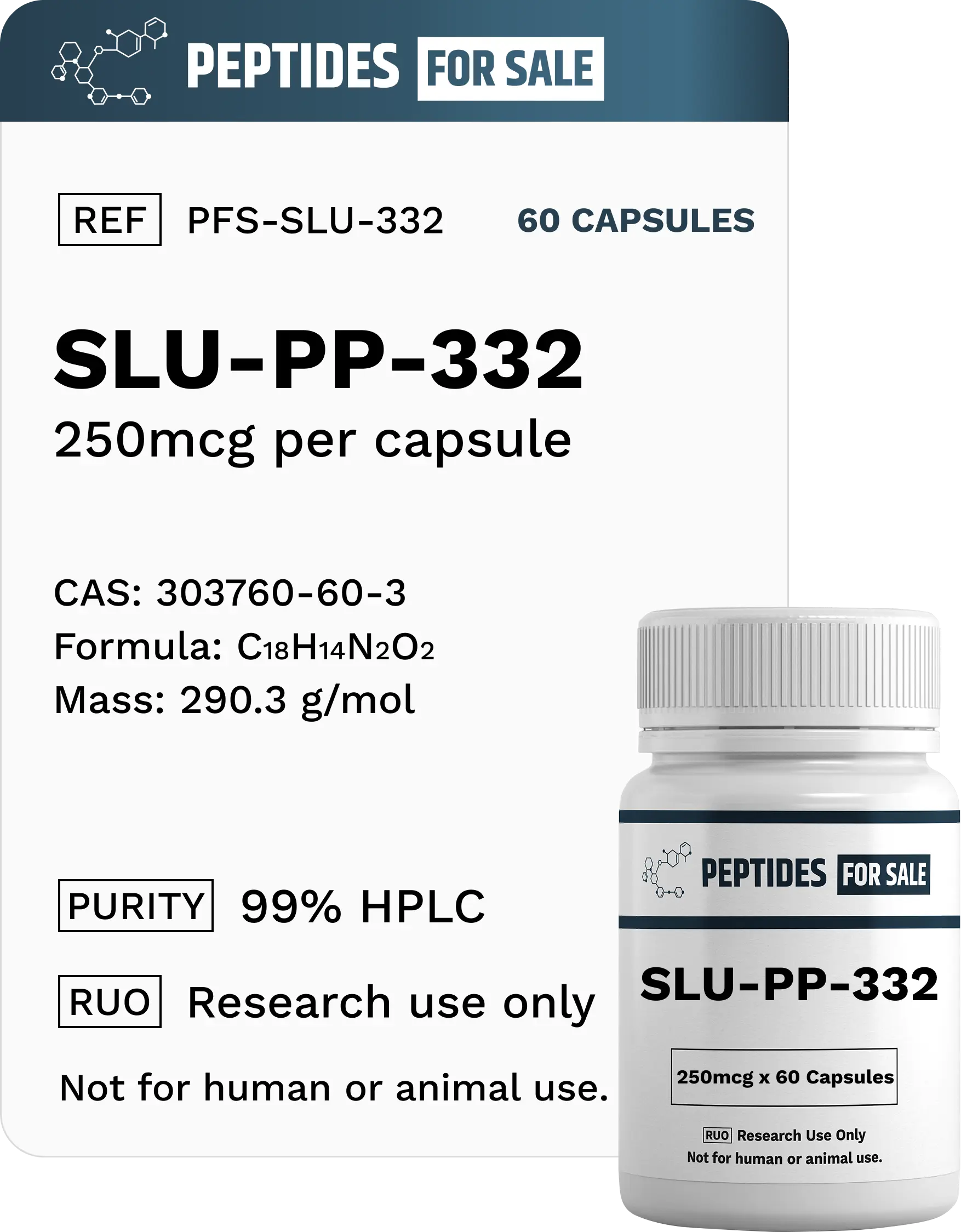
SLU-PP-332 is a synthetic small molecule, not a peptide, that activates the estrogen-related receptors ERRα, ERRβ and ERRγ, with its highest potency at ERRα. It was designed by Thomas Burris’s group and collaborators at Saint Louis University as a pan-ERR agonist. In mice it increased oxidative type IIa muscle fibers, running endurance and fat oxidation. No human trials are registered on ClinicalTrials.gov (searched September 2026), and the published studies we found were all in cells or animals.
Key takeaways
SLU-PP-332 is often listed next to peptides, but chemically it has little in common with them. PubChem gives its structure as 4-hydroxy-N-[(E)-naphthalen-2-ylmethylideneamino]benzamide, a molecule with 18 carbon atoms and no amino acid residues (PubChem). It belongs to a class of compounds called acyl hydrazones. Research-grade SLU-PP-332 is available for laboratory use.
The compound grew out of an older research tool. GSK4716 is an ERRβ/γ-selective agonist with only very weak activity at ERRα. In the design described by Billon et al. 2023, the team replaced the isopropyl phenyl group of GSK4716 with a more hydrophobic naphthalene group. Their aim was to reach Phe328, a residue specific to the ERRα binding pocket. The result was a roughly 50-fold gain in ERRα potency.
In full-length ERR cotransfection assays, SLU-PP-332 had EC50 values of 98 nM at ERRα, 230 nM at ERRβ and 430 nM at ERRγ. GSK4716, by comparison, had EC50 values above 5,000 nM at ERRα and ERRβ. SLU-PP-332 was 4.4-fold more selective for ERRα than ERRγ and 2.3-fold more selective for ERRα than ERRβ. It did not change the activity of ERα, ERβ or other nuclear receptors tested in the same assay format (Billon 2023). The point matters because the names invite confusion: ERRs are separate receptors from the classical estrogen receptors.
The estrogen-related receptors ERRα, ERRβ and ERRγ are orphan nuclear receptors, and genetic studies tie them to skeletal muscle exercise capacity (Billon 2023). The Billon team described ERRα as having “strong constitutive activity” on its own. That is one reason it was unclear whether any small molecule could push it further. Before SLU-PP-332, agonists existed for ERRβ and ERRγ, but designing compounds with ERRα agonist activity had proved difficult.
ERRα’s best-known partner is PGC-1α, a transcriptional coactivator that training activates in muscle (Narkar 2008). In a 2004 study, Schreiber et al. showed that ERRα acts as an effector of PGC-1α. When ERRα was blocked, PGC-1α could no longer drive expression of mitochondrial genes or increase mitochondrial DNA. A constitutively active form of ERRα was sufficient to produce both effects. The authors also noted that the ERRα-regulated genes they identified had been reported at lower levels in insulin-resistant people.
The three subtypes do not behave identically. In skeletal muscle, the endurance effect of SLU-PP-332 depended on ERRα (details below). In the heart, ERRα and ERRγ both regulate metabolism. In a mouse heart-failure study, however, ERRγ turned out to be the main mediator of the effects of pan-ERR agonists (Xu 2024).
Two papers from the Burris group carry most of the weight in discussions of SLU-PP-332. Both gave the compound by intraperitoneal injection, 50 mg/kg twice daily in most experiments (Billon 2023; Billon 2024).
The earlier of the two papers, published in ACS Chemical Biology, set out to show that SLU-PP-332 could be used as an ERR probe in live animals (Billon 2023). The main results were:
The knockout experiment is the strongest part of the paper. It links the endurance effect to ERRα in muscle and makes an off-target explanation less likely. The paper also carries a disclosure: three authors, including Burris, held stock in Myonid Therapeutics (Billon 2023).
The follow-up study in the Journal of Pharmacology and Experimental Therapeutics tested SLU-PP-332 in two mouse models of metabolic syndrome (Billon 2024). Twenty-week-old male C57BL/6J mice kept on a 60% fat diet (the diet-induced obese, or DIO, model) were treated for 28 days. Leptin-deficient ob/ob mice were treated for 12 days. The authors shortened the ob/ob study because the animals showed reduced tolerance of twice-daily intraperitoneal injections.
In the DIO mice, the reported findings were:
Liver triglycerides fell in the DIO mice, and the substantial hepatic steatosis of ob/ob mice was reduced. The abstract describes improved insulin sensitivity. Because the insulin tolerance test did not change, that conclusion rests on fasting values and glucose tolerance, not on every measure the authors ran.
SLU-PP-332 has since been tested outside muscle. In a mouse model of pressure-overload heart failure, SLU-PP-332 and a structurally distinct pan agonist, SLU-PP-915, improved ejection fraction, reduced fibrosis and increased survival without changing cardiac hypertrophy (Xu 2024). In 2026 the Burris group reported that SLU-PP-915 enhanced aerobic exercise performance in mice to a similar extent as SLU-PP-332 when both were injected (Billon 2026).
“Exercise mimetic” is a label for compounds that reproduce some molecular or performance effects of training in animals without the training. The four compounds below act at different points in the same broad network: the AMPK energy sensor, the nuclear receptors PPARδ and ERRs, and the coactivator PGC-1α.
| Compound | Type | Primary target | Main model findings |
|---|---|---|---|
| SLU-PP-332 | Synthetic small molecule | ERRα/β/γ agonist, most potent at ERRα | Mice: more type IIa fibers, ~70% longer and ~45% farther running, less fat gain in DIO mice (Billon 2023; Billon 2024) |
| AICAR | Cell-permeable AMP analog | AMPK activator | Sedentary mice treated for 4 weeks ran ~23% longer and ~44% farther; a set of 32 genes linked to oxidative metabolism was up-regulated (Narkar 2008) |
| GW501516 | Synthetic small molecule | PPARδ agonist | No endurance gain in sedentary mice; with 4 weeks of training, running time up 68% and distance up 70% vs trained controls (Narkar 2008). Development was discontinued after pro-oncogenic findings in animal studies (Cheng 2019). |
| MOTS-c | 16-amino-acid mitochondrial-derived peptide | Folate cycle inhibition leading to AMPK activation | Prevented diet-induced obesity and insulin resistance in mice (Lee 2015); improved physical performance in young, middle-aged and old mice (Reynolds 2021) |
The closest comparison is with AICAR, because both were tested as stand-alone treatments on treadmill endurance in sedentary mice. Narkar et al. 2008 reported that four weeks of AICAR alone raised treadmill running time by about 23% and distance by about 44%. Treated mice also had a lower epididymal fat-to-body-weight ratio and higher oxygen consumption with no change in body weight. SLU-PP-332’s reported gains were about 70% in time and 45% in distance after roughly a week. The two experiments used different treadmill protocols and timelines, so the numbers cannot be compared head to head.
The mechanisms differ. Narkar and colleagues describe AICAR as a cell-permeable AMP analog that activates AMPK, a kinase that training also activates, along with PGC-1α. SLU-PP-332 instead acts on the nuclear receptors that PGC-1α works through. Genetic data point the same way: in the Billon paper, the endurance effect of SLU-PP-332 disappeared when ERRα was removed from muscle.
GW501516 is included here because its history shows how a strong mouse exercise phenotype can end in a stopped program. In the 2008 Narkar study it did not improve endurance in sedentary mice on its own, but it amplified the effect of training. It later improved lipid profiles in short-term human studies. A 2019 review notes that two GSK abstracts reported cancers in rats and mice after 104 weeks of dosing. It adds that “the phase 4 trial (NCT00841217) was stopped” and that the World Anti-Doping Agency and Health Canada issued warnings (Mitchell 2019). A separate review states that development of GW501516 was discontinued because of pro-oncogenic properties seen in animal studies (Cheng 2019).
MOTS-c is a 16-amino-acid peptide encoded in the mitochondrial 12S rRNA gene. Its main target organ appears to be skeletal muscle. There it inhibits the folate cycle and de novo purine synthesis, leading to AMPK activation (Lee 2015). That puts it mechanistically closer to AICAR than to SLU-PP-332. In humans, exercise raised endogenous MOTS-c in skeletal muscle and in circulation (Reynolds 2021), which is an association finding, not a treatment result.
A search of ClinicalTrials.gov for “SLU-PP-332” returned zero registered studies when checked in September 2026. The same search for SLU-PP-915 also returned nothing, and we found no published human pharmacokinetic, safety or efficacy data for either compound. Every SLU-PP-332 endurance, body composition and metabolic result in this guide comes from mice or cultured cells.
Several features of the SLU-PP-332 record limit how far the mouse data can be extended.
None of this makes the findings wrong. The ERRα knockout result is a well-controlled piece of mechanism work. What the data support is that ERR agonism is a workable research strategy in rodents, not that SLU-PP-332 has any established effect in people.
No. SLU-PP-332 is a synthetic small molecule with the formula C18H14N2O2 and a molecular weight of about 290 g/mol. It is often sold alongside research peptides, which is where the confusion comes from, but its structure contains no amino acid residues.
An ERR agonist is a compound that increases the transcriptional activity of one or more estrogen-related receptors. SLU-PP-332 activates all three subtypes in reporter assays and is most potent at ERRα.
In mice it switched on part of the gene program that follows a single bout of aerobic exercise, including Ddit4 and Slc25a25. It also increased oxidative muscle fibers and treadmill endurance without training. The label describes those mouse findings. It is not evidence that the compound substitutes for exercise in humans.
For labs comparing ERR agonism with AMPK-driven models, Peptides For Sale supplies research-grade SLU-PP-332 alongside AICAR and MOTS-c for laboratory research. For guidance on certificates of analysis and third-party purity testing, see our guide on how to buy research peptides safely.
Research use only. SLU-PP-332 and all other products referenced in this article are sold strictly for in vitro and laboratory research by qualified professionals. They are not drugs, foods, dietary supplements or cosmetics, are not intended for human or animal consumption, and are not intended to diagnose, treat, cure or prevent any disease. The studies summarized here are reported for scientific information only and do not constitute medical advice or instructions for use.