
Thymalin is a complex of polypeptides extracted from calf thymus by mild acid extraction, developed as an immunomodulating drug by V. G. Morozov and V. Kh. Khavinson (Morozov and Khavinson 1997). It is an extract, not a single defined peptide, which sets it apart from synthetic thymic peptides such as thymogen (Glu-Trp) and thymosin alpha-1. Almost all of the later thymalin research, including its best-known longevity study, comes from the St Petersburg Institute of Bioregulation and Gerontology and its collaborators.
Researchers sourcing material for laboratory work can find the thymalin research peptide in the catalog. The rest of this guide covers what the primary literature says about the compound and how strong that evidence is.
The developers describe thymalin as a pharmaceutical made from “natural thymic peptides” isolated from calf thymus by mild acid extraction and “put into practice as immunocorrector” (Morozov and Khavinson 1997). Later work from the same institute calls it “a polypeptide complex isolated from the thymus” (Khavinson et al. 2020) and “a polypeptide extract of thymus” (Linkova et al. 2023).
That matters because extracts vary. A defined synthetic peptide has one sequence and one molecular weight that a certificate of analysis can confirm. An extract is a mixture, so its composition depends on the source tissue and the process used to make it.
Some product pages, including an earlier version of this article, describe thymalin as a synthetic tetrapeptide with the sequence Glu-Asp-Pro-Gly. We could not find that sequence attributed to thymalin in any PubMed-indexed paper by its developers or anyone else. The components the developers themselves name are two dipeptides: KE (Lys-Glu) and EW (Glu-Trp), which Linkova and colleagues call “the active substances of Thymalin” (Linkova et al. 2023).
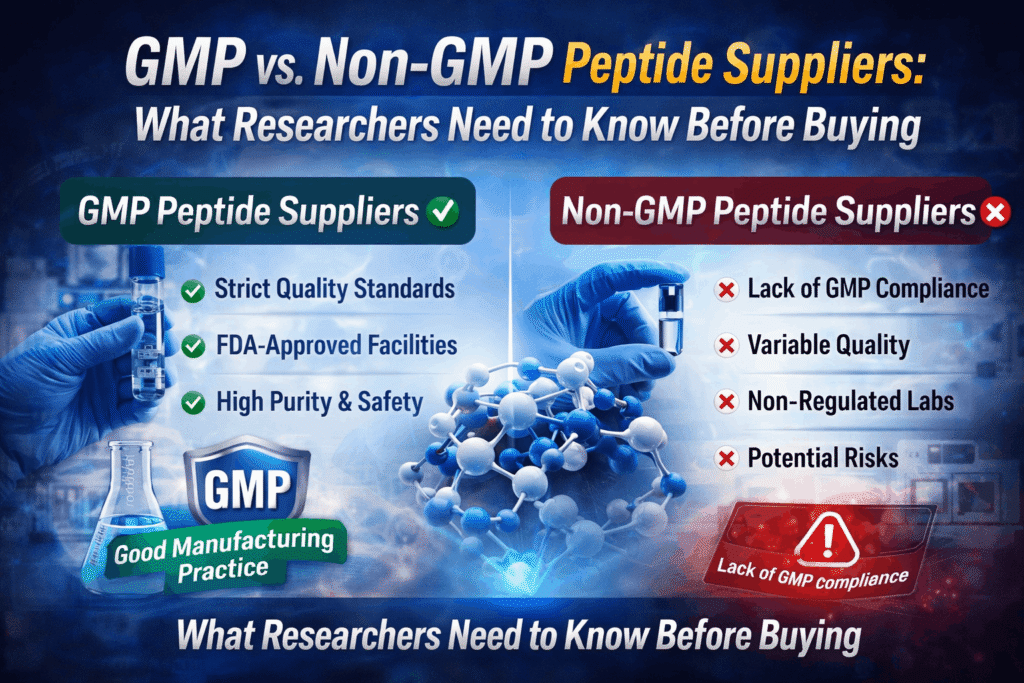
For laboratory work, the practical point is simple. A vial sold as “thymalin” should come with analytical data that states what it contains and at what purity. Our guide on checking purity testing and certificates of analysis covers what that paperwork should show, and our note on GMP and non-GMP peptide suppliers explains how manufacturing standards differ.
Thymogen grew out of thymalin but is a distinct product. Morozov and Khavinson report that one immunomodulatory molecule, L-Glu-L-Trp, was isolated from thymalin by reversed-phase high-performance liquid chromatography, and that thymogen was then “designed on the base of synthesized dipeptide” (Morozov and Khavinson 1997). The same paper describes a second synthetic immunomodulatory dipeptide, Vilon.
The 1997 paper also reports a difference between the natural and synthetic products. Both activated T-cell differentiation and changed IL-2 and interferon release from blood lymphocytes, but the synthetic dipeptides “had no influence on antioxidant response in thymocytes in comparison with natural peptides” (Morozov and Khavinson 1997). In other words, the authors themselves did not treat the extract and its isolated dipeptide as interchangeable.
Four thymus-related compounds often get mixed up in vendor copy. They differ in origin, size and how well they are characterized.
| Compound | Origin | Composition | Main research base |
|---|---|---|---|
| Thymalin | Extracted from calf thymus by mild acid extraction (Morozov and Khavinson 1997) | Polypeptide complex; KE and EW dipeptides named as active components (Linkova et al. 2023) | Mostly the St Petersburg Institute of Bioregulation and Gerontology and collaborators (Khavinson and Morozov 2003) |
| Thymogen | Isolated from thymalin by RP-HPLC, then made synthetically (Morozov and Khavinson 1997) | Dipeptide L-Glu-L-Trp (EW) (Morozov and Khavinson 1997) | The same Morozov and Khavinson group (Morozov and Khavinson 1997) |
| Thymosin alpha-1 | First isolated from calf thymus (thymosin fraction 5) in 1977 (Goldstein et al. 1977); drug form thymalfasin is synthetic | 28 amino acids, N-terminally acetylated, highly acidic (FDA 2024) | Clinical studies in hepatitis B and C, cancer and sepsis, reviewed by FDA (FDA 2024) |
| Thymulin | Hormone produced by thymic epithelial cells, identified in the early 1970s (Reggiani et al. 2009) | Nonapeptide (formerly called FTS) bound to zinc, which it needs for activity (Bach and Dardenne 1989) | Groups in Paris (Bach and Dardenne 1989) and La Plata, Argentina, including neuroendocrine and animal work (Reggiani et al. 2009) |
Thymosin alpha-1 is the compound most often compared with thymalin, and the two are easy to confuse because both trace back to calf thymus. The resemblance ends there. Thymosin alpha-1 is one defined 28-residue peptide with a known sequence; thymalin is a mixture. Our thymalin vs thymosin alpha-1 comparison covers that pairing and the thymosin alpha-1 trial record in detail.
Interest in thymic peptides rests on a well-documented feature of ageing. The thymus is where T cells mature, and it starts shrinking early. Palmer’s 2013 review describes age-associated thymic involution as a loss of tissue mass, cellularity and organization, “with the net outcome being a reduction in naïve T cell output” (Palmer 2013). The same review links that decline to reduced T-cell diversity and to greater susceptibility to infection, autoimmune disease and cancer in older people, and notes that involution begins before puberty.
A 2018 modelling paper in PNAS put a number on the trend. Combining immunology and epidemiology data, the authors wrote that in humans “the thymus atrophies from infancy, resulting in an exponential decline in T cell production with a half-life of ∼16 years” (Palmer et al. 2018). Their model, built on that decline, fitted age-related cancer and infection incidence data better than a comparable mutation-accumulation model.
Thymulin shows the same pattern at the hormone level: its production falls with age in animal and human studies (Reggiani et al. 2009). The hypothesis behind thymalin research is that supplying thymus-derived peptides might offset some of this decline. Whether it does in people remains unproven.
Thymalin was in clinical use in the Soviet Union by the early 1980s, when a paper in a Soviet physiology journal described it “in experiments and in clinical use” (Sofronov et al. 1984). The developers describe it as an “immunocorrector” and report that both thymalin and thymogen “were used in persons with chronic pathology and immune dysfunction” (Morozov and Khavinson 1997). Much of this older clinical literature appeared in Russian-language journals, and many of those records in PubMed have no English abstract. That makes the underlying methods hard to assess from outside.
The most cited human study is a report by Khavinson and Morozov in Neuro Endocrinology Letters. Researchers from St Petersburg and the Institute of Gerontology in Kiev followed 266 elderly people for 6-8 years; the peptide preparations thymalin and epithalamin (a pineal extract) were given during the first 2-3 years (Khavinson and Morozov 2003).
The authors reported the following, compared with a control group:
These are large effects, and they need careful reading. The abstract does not describe how participants were allocated, whether the study was blinded, or whether the control group received a placebo. The study was run by the drug’s developers, and we found no independent trial that has reproduced these mortality results. Until that happens, the findings are best treated as a hypothesis worth testing.
More recent thymalin papers are laboratory studies. In a 2020 study on human hematopoietic stem cells, thymalin reduced expression of the stem cell markers CD44 and CD117 by 2-3 times. It also increased expression of CD28, a marker of mature T lymphocytes, by 6.8 times, which the authors read as a push toward T-cell differentiation (Khavinson et al. 2020).
A 2023 study combined molecular docking with an in vitro inflammation model. In lipopolysaccharide-stimulated human peripheral blood mononuclear cells, thymalin and the KE and EW dipeptides lowered IL-1β, IL-6 and TNF-α production by 1.4-6.0 times (Linkova et al. 2023). Thymalin itself had the weaker effect: it cut LPS-induced TNF-α release 2.2-fold, against 6-fold for KE and 5-fold for EW. Blood samples came from four healthy donors. The same paper cites earlier reports of thymalin use in severe COVID-19, but the 2023 study itself did not involve patients.
The animal lifespan evidence comes from the same network. In a 1989 study co-authored by Khavinson and Morozov, female mice given a thymus-derived polypeptide factor lived longer only when treatment started young, not in middle age. In young mice it also lowered overall tumour incidence and cut mammary adenocarcinoma incidence 1.8-fold, with no antitumour effect in mature mice (Anisimov et al. 1989). The abstract calls the material a thymus-derived polypeptide factor and does not name it as thymalin. We found no independently replicated animal lifespan data and no formal toxicology studies of thymalin published in English.
Taken together, the thymalin literature has three limits that any researcher should factor in:
None of this shows that thymalin is inactive. It means the claims made for it, especially lifespan claims, rest on a narrow and largely unreplicated base.
Both descriptions appear, but the primary sources describe an extract: a complex of polypeptides obtained from calf thymus by acid extraction (Morozov and Khavinson 1997). It is not a single synthetic sequence.
No. Thymogen is the synthetic dipeptide Glu-Trp. It was identified as one component of thymalin and then produced synthetically as a separate drug.
No. Thymosin alpha-1 is a defined 28-amino-acid peptide first sequenced in 1977 (Goldstein et al. 1977). Thymalin is a polypeptide mixture. Both are derived from calf thymus, but they are different materials.
We found no randomized, placebo-controlled thymalin trial run by an independent group outside the Russian research network. The human evidence comes mainly from the developers’ own studies.
Peptides For Sale lists thymalin for in vitro and laboratory research with batch documentation. Given the questions about what the name covers, check the certificate of analysis for identity and purity data before using any lot in an experiment.
Research use only: Thymalin sold by this store is intended strictly for in vitro and laboratory research by qualified professionals. It is not a drug, food or dietary supplement, is not intended for human or veterinary use, and is not intended to diagnose, treat, cure or prevent any disease. The information in this article summarizes published research for educational purposes and is not medical advice.